Islam Di Sabah
ISLAM IN SABAH
The earliest evidence of Islam’s existence in Sabah was an ldahan manuscript found at Sepagaya Village, Lahad Datu dated 1408 AD. (810 H/811 H). It recorded the conversion of Abdullah to Islam at Darvel Bay. By the 16th century AD. part of the population of Sabah had adopted Islam as their religion. At the time, Sabah was divided into 3 zones: The West Coast was controlled by the Brunei Sultanate, the East Coast was run by the Sulu Sultanate and the other areas were controlled by the syariff (nobleman). This enhanced the spread of Islam.
There were several serious oppositions mounted by the Muslims during the British colonial era. These were caused by cultural differences. The first known uprising was initiated by Datu Tating at Balambangan Island in 1775 AD (1188 H/1189 H). It was then followed by Syarif Usman at Marudu Bay. When the post of Resident was introduced in Sandakan, Paduka Mat Salleh opposed to the idea and launched uprisings against the British. He was killed on 31st January 1900 AD (29 Ramadan 1317 H). In the early 1900’s, the British made an effort to curb the spread of Islam. A number of rules were made prohibiting the Muslims from moving to stay in non-Muslim areas. However, the attitude of the British later changed by involving Muslim leaders in the administration. This avoided the opposition from the Muslim community.
The Muslim leaders went on to establish Islamic associations. Finally, the Persatuan Islam Putatan (Putatan Islamic Association) was formed in 1959 AD. (1378 H/1379 H). The Persatuan Islam Tawau (Tawau Islamic Association) was founded by Datuk Haji Abu Bakar Titingan. Haji Yusof Shamsuddin founded the Persatuan Islam Sabah (Sabah Islam Association). All the association were dissolved upon the establishment of the Pertubuhan Islam Seluruh Sabah (United Sabah Islamic Association) or USIA in 1969 AD. (1388 H/1390 H). Furthermore, the Majlis Ugama Islam Sabah, (MUIS) or Sabah Islamic Council, was established in 1971 AD. ( 1390 H/1391 H ). Islam was made the official religion on 23rd. September 1973 AD. (25 Syaban 1393 H). Tun Datu Haji Mustapha became the first Muslim Chief Minister of Sabah from June 1967 till October 1975. Prior to this, he was the first Sabah Head of State from 16th. September 1963 till 15th. September 1965. The Muslim population of Sabah constituted 61.40% of the total population of Sabah (1,730,098) according to 1991 census or 1,062,280.
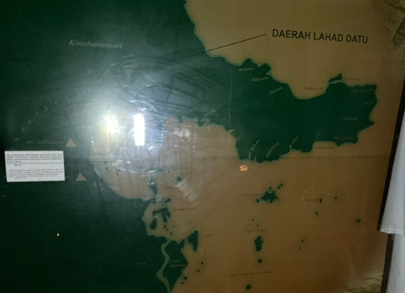
A map showing the location of Lahad Datu District in 1857 A.D ( 1237H/1274H ), Abdullah, who was an ldahan was converted to Muslim by Sharif Awliyyah AI-Makhdum at Darvel Bay.
Extracted: “The Origin and Early Development of the Tawau Community 1880-1942” Book
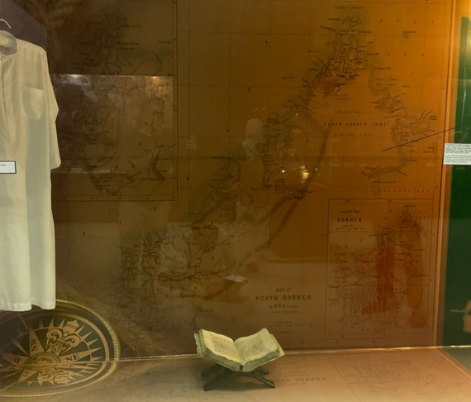
Peta Sabah menunjukkan pertapakan Islam di Sabah oleh 2 buah kuasa de facto Kesultanan Islam; Kesultanan Brunei (Pantai Barat dan Pandasan ke Kimanis ) dan Kesultanan Sulu (Pantai Timur dan Teluk Marudu ke Sungai Sibuga) pada abad ke 16M ( 10H/11H ).
Petikan : Buku ” Tuntutan Filipina Ke atas Sabah”
A map of Sabah showing the Islamic base in Sabah by 2 de facto power; the Brunei Sultanate (West Coast and Pandasan to Kimanis) and Sulu Sultanate (East Coast and Marudu Bay to Sungai Sibuga) in 16th century A.D ( 10H/11H ).
Extracted: “Tuntutan Filipina Ke atas Sabah” Book.
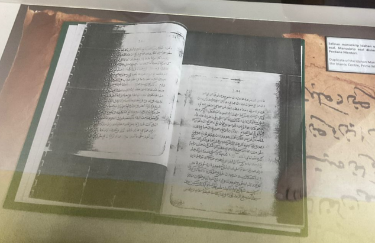
Salinan manuskrip Idahan yang disalin daripada manuskrip asal. Manuskrip asal disimpan oleh Pusat Islam, Jabatan Perdana Menteri.
Duplicate of the Idahan Manuscript. The original copy is kept at the Islamic Centre, Prime Minister’s Department.
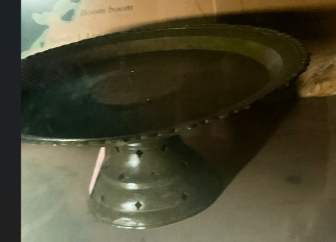
Talam Tembaga berkaki (Tabak) digunakan oleh suku kaum bajau untuk menghidang makanan atau untuk meletakkan barang-barang hantaran perkahwinan (berian).
Brass tray with stand (tabak) used by to Bajau community to serve food or to put sum given by a bridegroom’s.
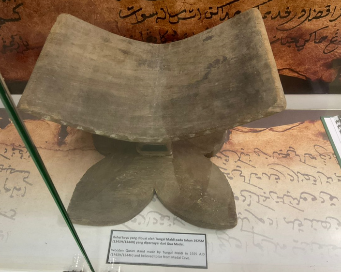
Rehal kayu yang dibuat oleh Tungal Maldi pada tahun 1925M (1343H/1344H) yang dipercayai dari Gua Madai.
Wooden Quran stand made by Tungal Maldi in 1925 A.D (1343H/1344H) and believed to be from Madai Cave.
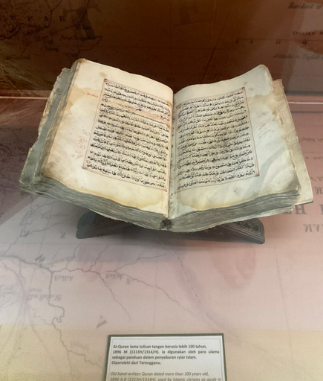
Al-Quran lama tulisan tangan berusia lebih 100 tahun,1896 M (1313H/1314/H). la digunakan oleh para ulama sebagai panduan dalam penyebaran syiar Islam. Diperolehi dari Terengganu.
Old hand-written Quran dated more than 100 years old,1896 A.D (1313H/1314H), used by Islamic clergies as guide in the spreading of Islam. Acquired from Terengganu.
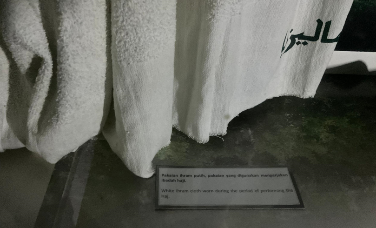
Pakaian ihram putih, pakaian yang digunakan mengerjakan ibadah haji.
White ihram cloth is worn during the period of performing the Haj.
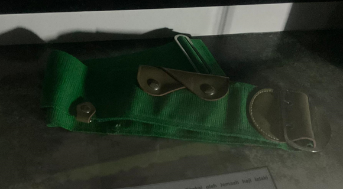
Tali pinggang yang biasa dipakai oleh Jemaah haji lelaki Malaysia.
Belt is usually worn by men from Malaysia performing the haj.
Songkok digunakan sebagai penutup kepala bagi lelaki Islam.
Songkok, is used as a head cover for Muslim men.
Tasbih, digunakan ketika beribadah khususnya berzikir dengan memuji nama Allah.
Tasbih, is used during praying, especially during the ‘Zikir’ praising the name of Allah.
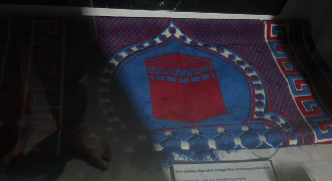
Kain Sejadah , digunakan sebagai tikar sembahyang umat Islam.
Sejadah cloth is used as a mat during praying.
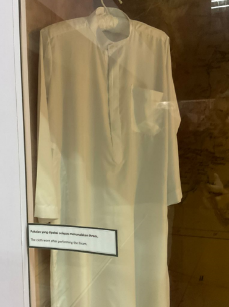
Pakaian yang dipakai selepas menunaikan ihram.
The cloth was worn after performing the ihram.
Copyright @ 2024 Museum Tun Sakaran. Collaboration work with Sunway University.